
So youve decided to go for your PMI certification – Huge move – that one decision could change your career path overnight & open doors to new & better jobs. But let’s be real for a second, getting that PMP credential after your name isn’t a walk in the park. The exam is a real challenge – it’s trying to see how you think, not just what you know. Now, a lot of people think studying the guides & watching videos is enough, but that’s where a lot of smart folks get stuck – they don’t put themselves to the test before the big day. That’s where the PMP practice exam comes in – it’s not just another study aid, it’s one last rehearsal before you put everything together on the big day.
What Is PMI Certification and Why It Matters
Understanding PMI and the PMP
First of all, the PMI Certification is the Project Management Institute and they’ve got a pretty firm grip on this field. When we talk about PMI certification, the PMP (short for Project Management Professional) is usually the first thing that comes to mind. And that’s for good reason it’s the standard by which all other project management credentials are measured, essentially making it the gold standard of project management diplomas. It shows the world you’ve got a decent handle on leading and directing projects.
The Very Real Benefits of PMP Certification
So why do people put up with months of gruelling study to get this thing? Well ,the reasons are pretty compelling.
- Career Advancement: It puts you ahead of the pack. When two resumes are being a looked over by a hiring manager, the one with “PMP” on the top is going to get a lot more attention. And it can be the key to getting from a team member to a project leader.
- Pay Rise: The numbers don’t lie. Professionals who have got their PMP consistently report higher median salaries than those who don’t have it. That’s a pretty clear indication that having a PMP has a direct impact on how much you can earn.
- Global Recognition: The PMP isn’t just some local certification, it’s a global ticket that allows you to speak a common language of project management that organisations world wide understand and respect.
Understanding the PMP Exam Structure: What You’re Up Against
Preparing well for the PMP exam is tough if you don’t even have a clue what the exam is actually about. The current PMP exam questions are built around three major areas, or “domains” and that’s your starting point.
The 3 Key Stakes of the PMP Exam
- People – this one’s all about the interpersonal skills. It’s about leading a team, diffusing conflict, making sure your team is actually hitting. It’s targets and keeping all the stakeholders happy. About 42% of the exam is centred around all that soft stuff.
- Process – This is the meat and bones of it all. It’s the nitty gritty on managing scope, schedule, budget, resources, risks & all that jazz. That makes up about 50% of the test.
- Business Environment – This is the bit that shows you how your project fits into the bigger picture of the organisation. How you work with compliance, delivering real value to the business and helping drive change from the inside. Its a small 8% now, but more than you might think!
Question type & Logistics
Forget about easy definition questions, the PMP exam is actually pretty tough and mostly filled with scenario based questions. You’ll get some kind of situation in a paragraph and be expected to tell them what you would do next or what the best course of action is.
- Format: All multiple choice but with some trick questions like matching or multiple answers.
- Question count: 180
- Time allowance: 230 minutes which includes any breaks you choose to take. Though be warned, that’s only about 1.3 minutes per question on average
PMP Practice Exams: What Are They, Really?
More Than Just a Quiz
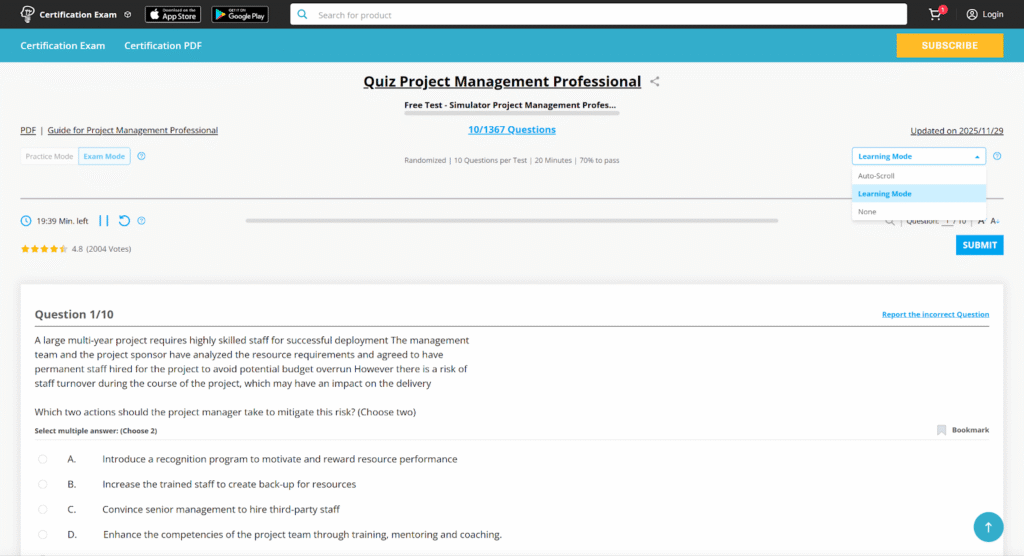
A PMP practice exam is a simulated version of the real test. Basically a trial by fire that helps you get used to how the real thing feels. Its main aim isn’t just to test your knowledge, but to toughen you up, simulate the pressure of the clock ticking away & the slightly odd way the questions are worded – think of it a bit like a flight simulator for project managers.
Tailor Your Prep with These Different Types
- Timed / Full-Length Mock Exams: This is the main test simulation where you sit down and do the full load of questions under the exact same time limits as the real exam – there’s no better way to build up your endurance & time management skills than this.
- Topic Wise Quizzes: These allow you to target specific problem areas – stuck on Risk questions? Then try a 20-question mini-quiz just on that topic.
- Adaptive Tests: Some platforms, like Certification-Exam, have this nifty feature where the questions get harder or easier depending on how you’re doing, making it a very efficient way to identify and smash through your weak points.
Why PMP Practice Exams Are Critical to Your Success
Skipping practice tests for the PMP prep is probably your strategic error. Here’s why you really can’t afford to do without them.
They Make Your Knowledge Stick
Reading about a concept is one thing. But getting the hang of actually applying it to a tricky question ? That’s a whole different ball game. Practice exams make you dig into your memory and put your knowledge to the test. And that’s what truly gets those ideas locked into your long term memory – not just re-reading about them.
They Teach You How to Manage Your Time Fast
You might know your way around the PMBOK guide in theory, but if you can’t get your knowledge out the door in time under timed conditions, you’re not going to pass. Taking a full length PMP practice exam will give you a sense of your natural rhythm – when to spare some extra time on tricky questions and when to just move on. You learn to pace yourself.
They Give You a Confidence Boost You Need
Walking into a real test center having never sat through a 3-4 hour test is a sure fire way to get your nerves in a twist. By taking a few practice tests under your belt, you build a sort of muscle memory. The real test starts to feel more like a familiar long walk, rather than a daunting mountain to climb. And that calm confidence can make all the difference between passing and failing.
How to Pick the Best PMP Practice Exams (What to Look For)
Not all practice exams are created equal, some can even do a lot more harm than good if used improperly. Here’s what you need to watch out for
Make Sure the Practice Exam Aligns with the Latest Exam Content Rules
This is the first rule to remember – the practice test has to be based on the very latest official Exam Content Outline put out by PMI Certification. The domains and the percentage of the tasks should match. Use an outdated test & you’ll be studying the wrong stuff.
Realistic Question Difficulty & Style That Matches the Real Exam
The questions should be posing the same kind of scenario-based “What do you do next?” style questions you’ll see on the actual exam. And they should be just as tough. If the questions come across as too easy or are just simple definition questions – time to look for a different source.
Detailed Explanations to Help You Learn from Your Mistakes
Getting a question wrong is a chance to learn – but only if you understand what you got wrong. The best practice exams give you all the answers – right and wrong – and back it up with a thorough explanation, referencing the specific guide (like the PMBOK Guide) where the concept comes from.
Strong Performance Analytics
Not all practice exams are created equal – some can even do a lot more harm than good if used improperly. Here’s what you need to watch out for:
Make Sure the Practice Exam Aligns with the Latest Exam Content Rules
This is the first rule to remember – the practice test has to be based on the very latest official Exam Content Outline put out by PMI Certification. The domains and the percentage of the tasks should match. Use an outdated test & you’ll be studying the wrong stuff.
Realistic Question Difficulty & Style That Matches the Real Exam
The questions should be posing the same kind of scenario-based “What do you do next?” style questions you’ll see on the actual exam. And they should be just as tough. If the questions come across as too easy or are just simple definition questions – time to look for a different source.
Detailed Explanations to Help You Learn from Your Mistakes
Getting a question wrong is a chance to learn – but only if you understand what you got wrong. The best practice exams give you all the answers – right and wrong – and back it up with a thorough explanation, referencing the specific guide (like the PMBOK Guide) where the concept comes from.
Best Practices for Using PMP Practice Exams the Right Way
Having the tool is one thing. Using it correctly is another.
Integrate Them Early and Schedule Them Regularly
Don’t save your first practice exam for the week before the real thing – it’s way too late by then. Start taking a series of shorter quizzes right from the beginning of your study plan. And for goodness sake – schedule a full mock exam or two at key points in your study – maybe after you’re done with the initial round of studying, and definitely just before the real thing to make sure you’re on track.
Review every single one of those answers
This is way more important than actually taking the test itself – and I mean that in a good way. For every question, take the time to read the explanation. Don’t just gloss over the ones you got right, make sure your reasoning was actually correct. And for the ones you got wrong, really try to understand what you did wrong. This review process is where the real learning happens – probably around 80% of it.
Don’t get too hung up on the score, focus on understanding
Its easy to get caught up in your percentage score. But try not to let that be your only goal. A 70% on a brutal, realistic test is better than a 90% on an easy one. Look at the score as a rough guide, but really let the analytics and explanations guide what you do next.
Use practice exams as part of a bigger picture
Practice exams aren’t meant to replace the other study materials you’ve got – they’re meant to be used alongside them. So keep using the PMBOK Guide, the Agile Practice Guide, and a good prep course. The practice test will show you where you need to improve, and the official study materials will help you actually fill in those gaps.
Common PMP Exam Prep Mistakes to Avoid
lets take a page from other people mistakes so you don’t have to go through the same struggles
Don’t just see practice exams as a one time deal, a final hurdle to clear. This is the biggest mistake. If you only take one at the end, you’re not giving yourself a chance to improve on the areas you struggle with, and it becomes just a grade rather than a valuable tool for learning.
- Failing to use the feedback and analytics from your practice exams is just like not learning from your mistakes. Getting a 65% and saying “i need to study more” is basically just repeating the same phrase over and over like a broken record – it does not help you at all. The analytics are there to show you exactly where you need to focus your studying so you don’t waste time.
- Memorising the answers to practice exam questions rather than understanding the underlying concept is pretty pointless in the end. Take the same test five times and you’ll start to memorize the answer letters, which wont be of much use come test day. But if you’ve taken the time to understand why the answer is the way it is, you’ll be able to answer any variation of the question.
- Using outdated study materials or buying up “brain dump” notes from friends who took the test ages ago may seem like a good way to save some cash but it will only end in tears. The exam changes constantly so dont be trying to rely on stuff that is years out of date. stick to the latest, reputable sources – its the only way to get what you need to pass.
Real Stories: How Practice Exams Made the Difference
“I failed my first attempt,” says a now-certified PMP. “I had studied all the books but only did a few random quiz questions online. For my second try, I committed to taking four full-length, timed practice exams. The first one was a wake-up call—I didn’t finish. By the fourth, I had my timing down and my confidence was back. I passed with flying colors. Those simulations were everything.”
The lesson here is universal. The practice exam translates knowledge into performance. It’s the bridge between studying and succeeding.
Conclusion: Your Path to PMI Certification Starts Here
Now it’s time to tie up a few loose ends. Getting your PMI Certification is no easy feat, and the PMP exam is what causes all the stress & anxiety. To actually pass, you’ll need a plan that goes way beyond just trying to cram the material. You’ve got to step into the exam room in your head, not just read about it in some boring old book.
Find a really reliable, realistic practice test platform that fits your learning style. Set a date a few weeks down the line to take your first full-length mock test and see where you stand. Then use that feedback to guide you from there. Keep studying, keep taking practice tests, and keep going back to review the areas that’s giving you trouble. Your PMI Certification is actually within grasp it’s not just some far-fetched dream. And with the right use of a PMP practice exam, you’ll be walking into that testing center feeling a whole lot more confident.